George Washington University physicists devise formula to forecast chatbot failure

Artificial intelligence research has taken a fascinating turn as physicists at George Washington University develop a mathematical formula designed to predict precisely when an AI chatbot will transition from providing helpful answers to generating erratic or harmful outputs. By analyzing the internal dynamics of language models, the research team aims to pinpoint the exact tipping point where model degradation occurs. Early empirical tests conducted on smaller scale models have successfully backed up the theoretical framework, offering a new methodological approach to understanding stability in machine learning systems.
This development addresses one of the most persistent challenges in modern artificial intelligence deployment – the unpredictable nature of large language models. As these systems scale up in complexity, engineers have historically relied on trial and error, extensive red teaming, and post-release monitoring to catch hallucinations and erratic behavior. While various guardrails exist to keep chatbots on track, truly understanding the underlying mechanics of how and when a model loses coherence has remained an elusive goal for computer scientists and researchers alike.
For the broader cryptocurrency and blockchain sectors, where automated agents and AI integrations are increasingly handling complex financial workflows, predictability is paramount. Market participants deploying algorithmic tools need assurance that autonomous systems will not experience sudden behavioral shifts during high volatility events or critical smart contract interactions. A reliable method for calculating model stability could fundamentally change how developers assess risk before integrating third party intelligence into decentralized finance applications and trading bots.
Industry experts and machine learning researchers are taking note of the George Washington University study, viewing it as a bridge between theoretical physics and applied computer science. While many are eager to see if the formula scales effectively to the massive frontier models dominating the market today, the initial findings offer a refreshing analytical perspective. Instead of treating neural networks purely as black boxes, this approach treats model degradation as a measurable physical phenomenon with identifiable precursors.
As the research progresses, the next critical step will involve testing the formula on larger, production-grade models currently used across enterprise and consumer sectors. If the mathematical model proves scalable, it could become a standard diagnostic tool for AI developers seeking to certify the reliability of their systems. For users and investors relying on stable AI infrastructure, this shift toward quantifiable predictability marks a crucial step forward in maturity for the entire technology landscape.

CoinMagnetic Team
Crypto investors since 2017. We trade with our own money and test every exchange ourselves.
Updated: October 2026
From our insights:
Related news
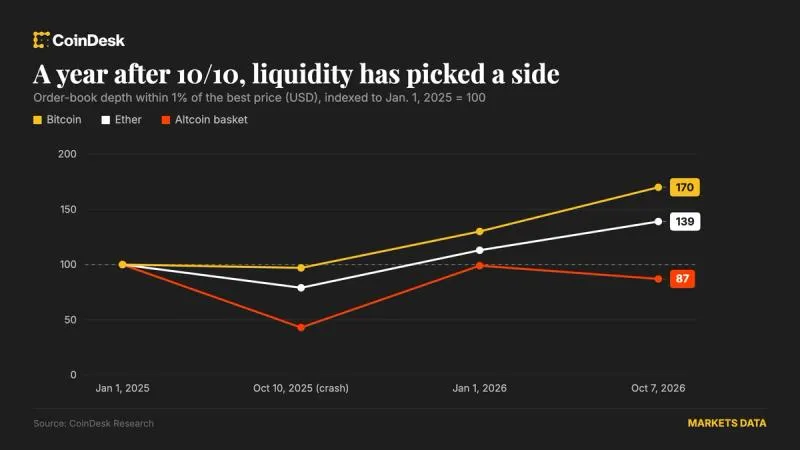
One year after 10/10 flash crash, bitcoin and ether liquidity have rebuilt, but altcoins still face risks

Tokenized commodities expand past gold into lending and oil markets

Justin Sun says Tron’s post-quantum cryptography has gone live on testnet

Traders adopt better risk tools one year after a $19 billion bitcoin flash crash

European tech leadership addresses growing worries over uncontrolled AI development