Charles Schwab, Citadel Securities weigh entering prediction markets

Recently, executives from Charles Schwab and Citadel Securities have expressed a growing interest in entering the realm of prediction markets. This emerging segment of the financial landscape allows participants to bet on the outcomes of various events, ranging from political elections to economic indicators. Notably, both firms have clarified that their potential ventures would avoid the sports betting space, indicating a focus on more traditional and potentially regulatory-friendly markets. This move signifies a noteworthy expansion for these financial giants, who are exploring innovative ways to engage with evolving market dynamics.
The concept of prediction markets is not entirely new; these platforms have been around for several years, gaining traction as alternative sources of information and sentiment regarding future events. While traditional betting focuses on sports and entertainment, prediction markets provide a more generalized approach, allowing users to speculate on a variety of topics. The interest from established firms like Charles Schwab and Citadel Securities can be seen as a validation of the potential this market holds, particularly as more investors seek out diversified avenues for financial engagement.
The implications of this development are significant for the broader market. The entrance of these major players could lend legitimacy to prediction markets, attracting more participants and increasing liquidity. As traditional financial institutions look to diversify their offerings, prediction markets may become an integral part of investment strategies, providing a new layer of insight into market sentiment and potential outcomes. Furthermore, as regulations around these markets evolve, the involvement of such well-established firms may help shape a framework that ensures compliance and fosters growth.
Industry reactions have been mixed, with some experts welcoming the move as a sign of maturity in the market, while others express caution about the regulatory challenges that may arise. Analysts point out that while the interest from Charles Schwab and Citadel Securities could drive innovation, it also raises questions about the ethical implications of making predictions on sensitive topics, such as elections and economic conditions. There is a palpable excitement, but also a sense of responsibility that comes with incorporating prediction markets into mainstream finance.
Looking ahead, it will be interesting to see how these firms navigate the complexities of entering the prediction market space. With regulators closely monitoring developments in the gambling and betting sectors, their approach could set precedents for the industry. As they explore potential partnerships or platforms, the outcomes of their ventures could either spark a new wave of investment opportunities or lead to a reassessment of how prediction markets are perceived in the financial ecosystem. The coming months will be critical as both firms continue to assess the landscape and determine their next steps.

CoinMagnetic Team
Crypto investors since 2017. We trade with our own money and test every exchange ourselves.
Updated: April 2026
From our insights:
Related news

Lummis blames Democrats for failed crypto Clarity Act vote
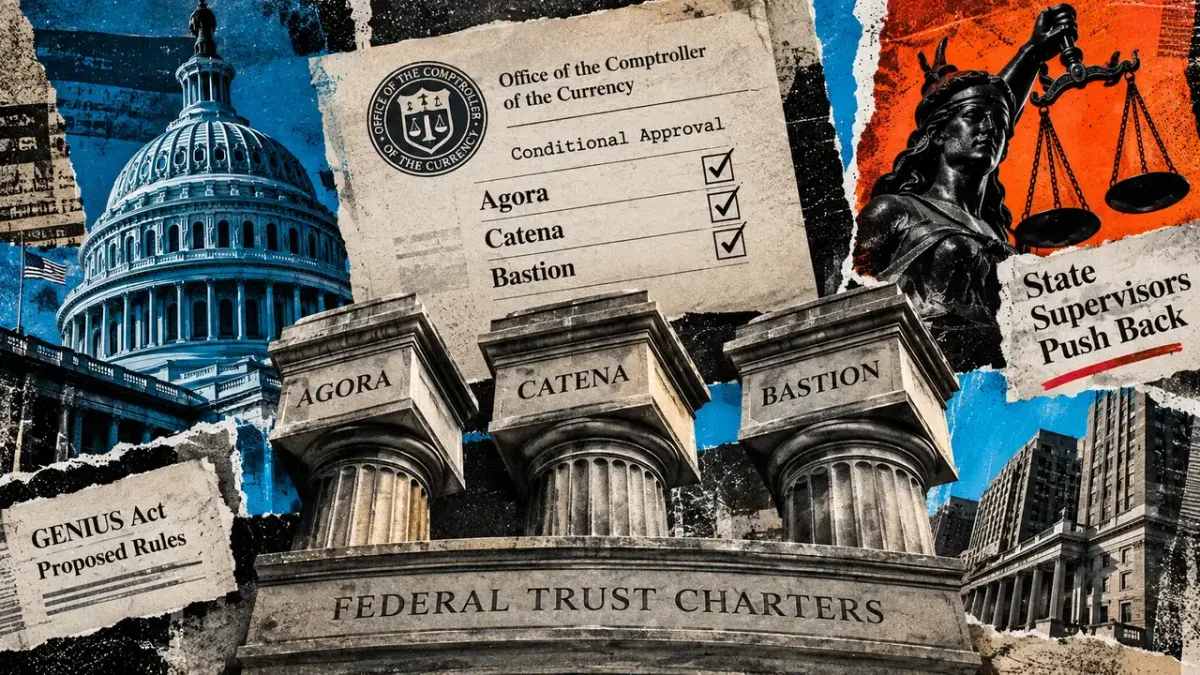
Federal approval won’t guarantee success for Agora, Catena, and Bastion

Regulatory clarity on crypto relies on officials, not Congress, says White House

PQLN enhances Bitcoin's quantum safety but raises privacy concerns for Lightning

Canada's major banks consider tokenized deposits for interbank payments